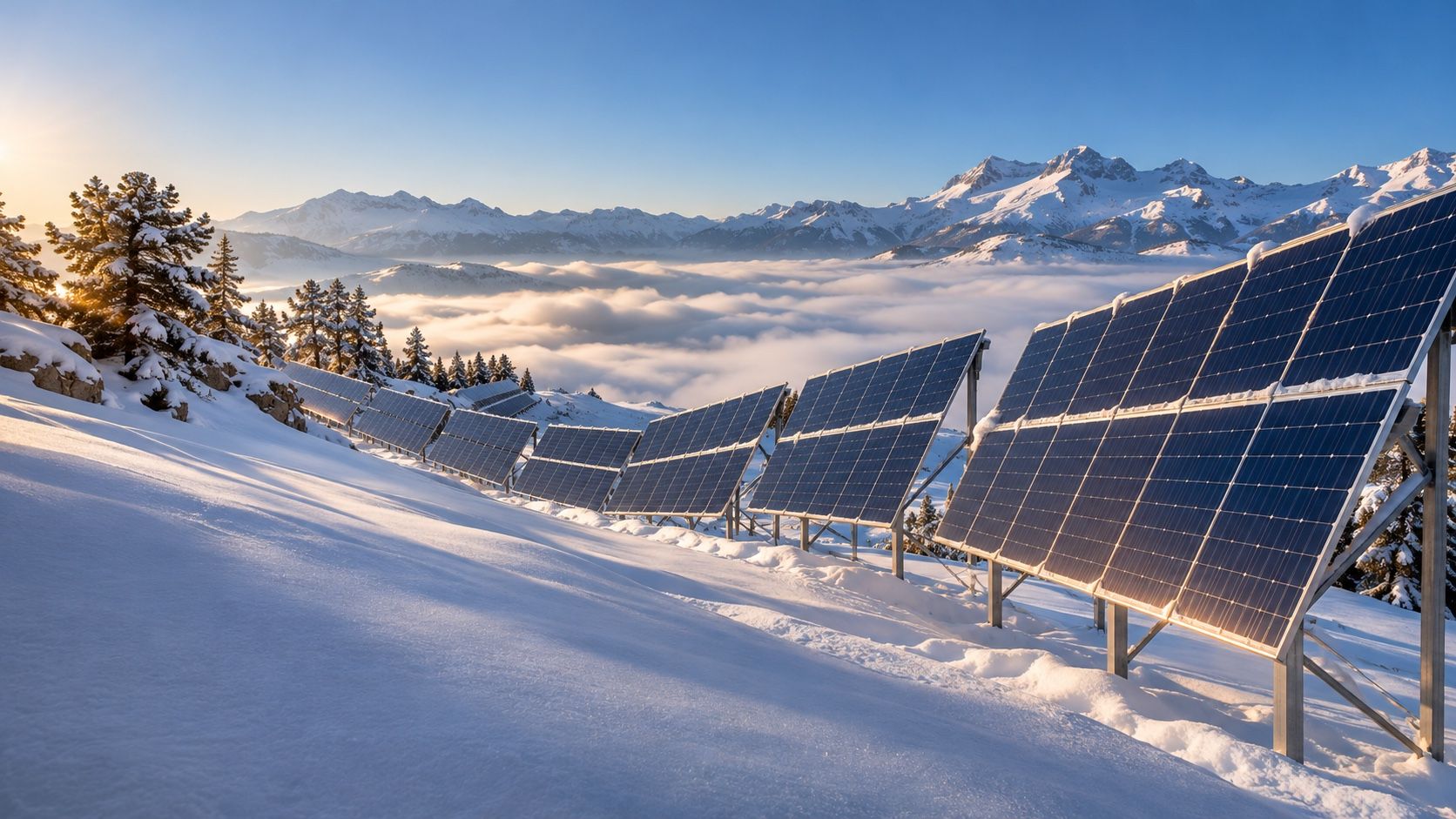
The problem: in December, a roof on the Swiss Plateau delivers only 1.9 percent of its annual output.17
So if you want to cover the winter with solar, you must build many times what is needed in summer. Facades and plants in the Alps help: they are mounted steeply, often sit above the fog, and snow reflects extra light. In December, an alpine plant delivers around 4 times as much as a roof on the Swiss Plateau.1113
- December, roof on the Plateau
- 17 kWh
- per kW of capacity
- December, alpine plant
- 74 kWh
- per kW of capacity
Try it yourself
The starting point is the year 2050: all nuclear plants are shut down, and consumption rises as the federal government expects. Build solar until the winter imports disappear.
Facades 10.0 GW, Wind 6.0 TWh, Roof cost 1’200 CHF/kW, Rate 3.0 %
- Used
- Could have been generated, unused
- Run-of-river plants
- Waste, wood, biogas
- Wind
- Solar, used
- Storage lakes
- Solar, unused
- Consumption
Consumption in 2050 as in the federal Energy Perspectives: 68.7 TWh per year. All nuclear plants are shut down. Above the consumption line: surplus that is exported or curtailed.
Compared with the expansion under the Electricity Act, winter imports fall by 5.5 TWh. This costs 2.3 bn CHF more per year, or 42.3 ct. per kWh of imports avoided.
It can be done.
With almost all suitable roofs, some of the facades, more alpine plants and a little more wind, Switzerland can do without winter imports. Around 59 percent of the solar power then goes unused.
It is not cheap.
Each kilowatt hour of solar power that is used then costs 26.8 ct. instead of 11.1 ct., because the unused ones are paid for too. Each kWh of imports avoided costs around 42.3 ct.. Imported power cost around 12 centimes in the winter of 2025.35
With wind, it is cheaper.
Wind turbines deliver two thirds of their power in winter.33 A mix with more wind and slightly less solar closes the gap for around 22.8 ct. per kWh of imports avoided.
What happens to the power nobody needs?
Nothing bad. The inverter, the device between the panel and the grid, moves the panels away from their best operating point. The panels then deliver less power. The light they do not turn into electricity becomes heat.
- A fully curtailed panel gets a good 5 °C warmer in the sun.19
- As a result, it ages slightly faster. For the Swiss climate, we estimate at most 0.1 percent extra per year, against a normal 0.5 percent. There are no Swiss measurements on this yet.
- Curtailment is already everyday practice: grid operators may curtail up to 3 percent of annual output without compensation.17 Since 2026, new plants feed in at most 70 percent of their capacity.18
- Panel delivers
- 181 W instead of 453 W
- Voltage
- 48.6 V instead of 42.2 V
- Panel warmer by
- around 3.3 °C
Simplified curve of a 450-watt panel in full sun. For illustration.
What is electricity in summer actually worth?
Almost nothing, at least around midday. Solar plants all over Europe are already pushing the price down. In June 2025, electricity on the exchange cost an average of 0.6 centimes per kWh around midday, and in 77 hours the price was even negative. In winter, electricity costs 1.3 to 1.6 times as much as in summer.35 So curtailing loses little.
- Average of all hours
- Midday, 11 am to 3 pm
Day-ahead exchange, Swiss bidding zone, monthly average. Red: number of hours with a negative price.35