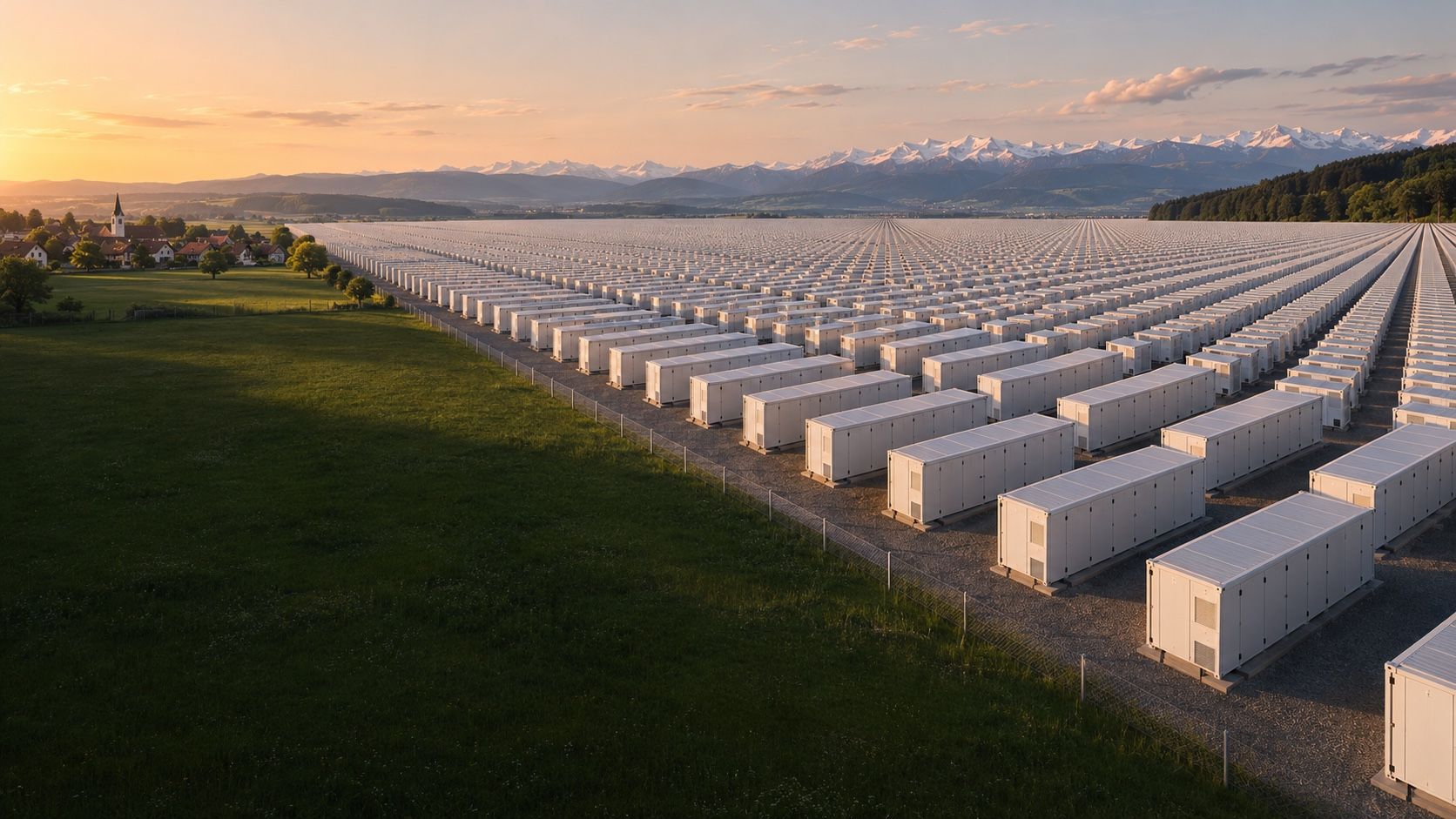
Technically, it would work. The problem is the price.
A lithium battery loses 1 to 3 percent of its charge per month, so at most about 15 percent over half a year.25 That would be bearable.
But a seasonal battery is charged and discharged only once a year. It has to earn its entire price with a single charge per year. The same battery, used every day, spreads its costs over around 300 charges. That is why batteries are cheap for balancing day and night, but not for balancing summer and winter.
How big would the battery have to be?
Starting point: expansion under the Electricity Act, all nuclear plants shut down. Set the size so that the winter imports disappear.
Starting point: expansion under the Electricity Act, all nuclear plants shut down. The battery charges with the summer surplus and discharges in winter.
The area is not the problem. The price is.
Areas to scale. Calculated with the density of a modern battery park, including spacing: 61 kWh per m². The city of Zurich covers 91.9 km².
New nuclear plant: BAK Economics estimate for an EPR with 1.6 GW, including interest during construction. Nant de Drance: pumped storage plant in Valais, stores 20 GWh. The battery here stores 300 times as much.
All containers in a row: 10’560 km. That is 26 % of the Earth’s circumference.
- Run-of-river plants
- Waste, wood, biogas
- Wind
- Solar, used
- Seasonal battery
- Storage lakes
- Solar, unused
- Consumption
The area would be fine.
A battery of 6 TWh would need around 98 km², about the size of the city of Zurich. That is a lot, but not impossible.
The price would not.
The same battery costs 1’320 bn CHF, more than the whole of Switzerland earns in a year. Each kilowatt hour from it costs around 21 francs.2324
Even much cheaper batteries are not enough.
Even at 80 francs per kWh of storage, each kilowatt hour in winter still costs around 8 francs. A winter kWh from a wind turbine costs around 20 centimes.